


Strengthen literacy. Reach more learners.
Strengthen the literacy instruction your district already uses with hands-on, differentiated support designed to reach more learners—without another oversized program or wholesale curriculum change
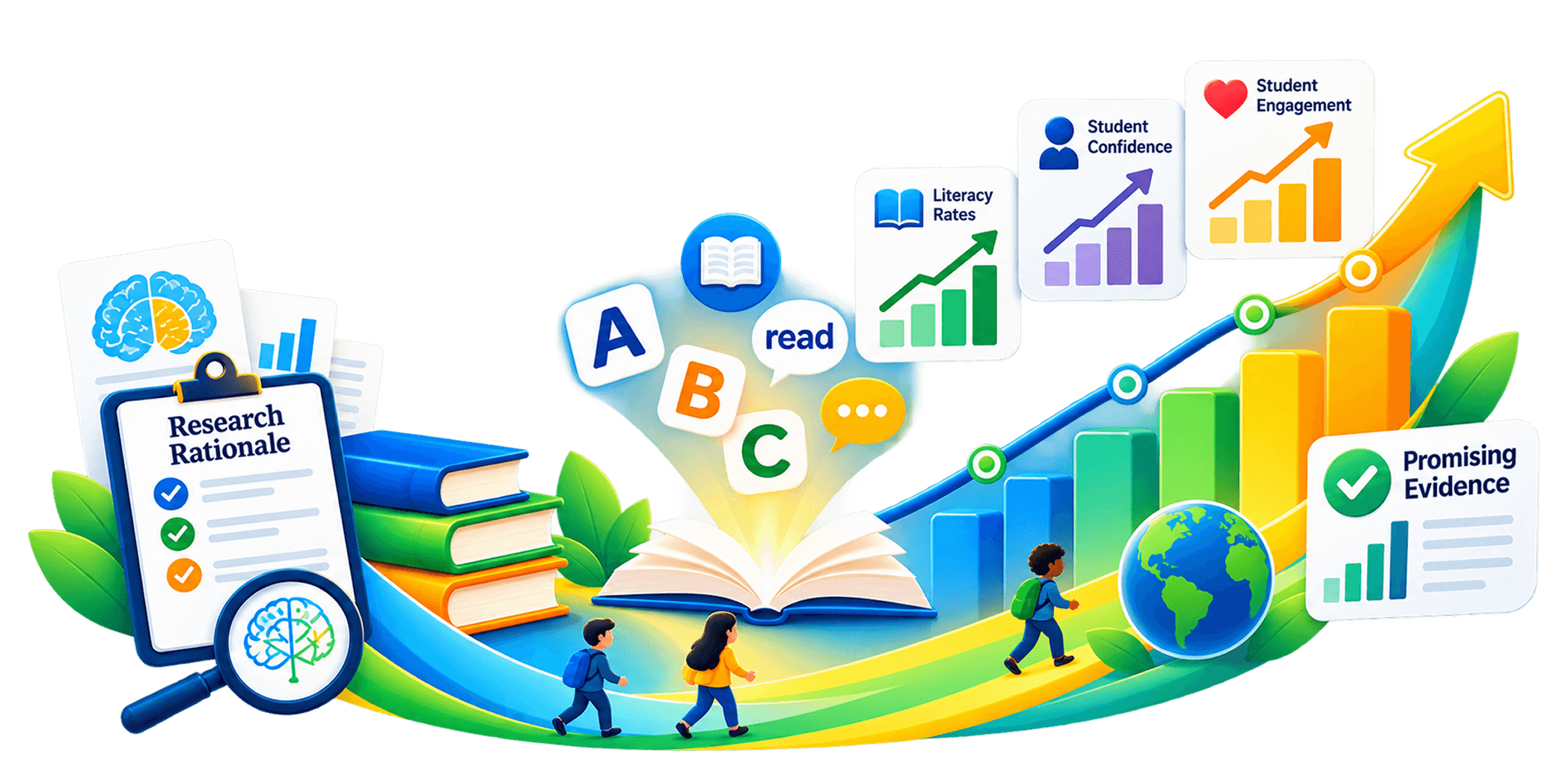
From rationale to promising evidence
Our evidence story has developed step by step. Each study has asked a different question—and each one has helped determine what we should study next.

Randomized Comparison
In 2026, Instructure conducted a small randomized feasibility study with transitional-kindergarten students.
What we learned: The results consistently favored BrainScience Works and demonstrated that a randomized study design is feasible—providing a strong foundation for the larger, adequately powered evaluation recommended by the researchers.
+26
points higher STAR Early Literacy scaled-score
higher than non-users and had higher adjusted scores across every exploratory literacy domain.
ESSA Level III - Promising Evidence
Instructure then examined implementation and literacy outcomes during a six-week school pilot. Among 26 K–2 students with complete pre- and post-data, greater time spent in BrainScience Works was significantly associated with higher letter-recognition outcomes after researchers controlled for students' starting performance (p = .020). The study met the criteria for ESSA Level III: Promising Evidence.
What we learned: The relationship predicted by the logic model began to appear in real student data, providing a reason to move toward more rigorous comparative testing.
33%
improvement in lowercase letter recognition
when compared with an 11% improvement among students who completed the school’s curriculum alone.
ESSA Level IV - Demonstrates Rationale
LearnPlatform by Instructure independently reviewed the research underlying BrainScience Works and worked with the team to develop a detailed logic model connecting program activities with intended literacy outcomes. The evaluation concluded that BrainScience Works met ESSA Level IV: Demonstrates a Rationale.
What we learned: There was a research-supported rationale for combining explicit literacy instruction with visual-spatial and multisensory learning—and a clear framework for testing whether that approach translated into student outcomes.
Conclusion
Satisfies Level IV criteria
- Detailed logic model informed by previous, high-quality research.
- Study planning and design is currently underway for ESSA Level I study.

The science behind another way in
Reading depends on more than phonological skills alone; research also points to the roles of visual attention, orthographic processing, memory, and motor experience in how students learn to recognize and remember print. BrainScience Works builds on that broader understanding by combining explicit literacy instruction with visual-spatial learning, hands-on construction, oral production, and handwriting—giving students multiple ways to connect with what they are learning.

Visual attention matters in reading: In a three-year longitudinal study, visual-spatial attention measured before children learned to read predicted later reading acquisition even after researchers controlled for age, nonverbal IQ, speech-sound processing, and other skills. The findings support the idea that learning to read depends on accurately attending to and organizing visual information as well as processing speech sounds View study.
Why it connects to BrainScience Works: Students are explicitly asked to notice the position, orientation, sequence, and distinguishing features of letters and words.
Reading improvement draws on more than one neural pathway: Following children with dyslexia for 2½ years, researchers found that right-hemisphere brain measures during reading were associated with future reading improvement. Together, two neural measures predicted which children would improve with 72% accuracy, while the behavioral measures used in the study did not reliably predict those gains View study.
Why it connects to BrainScience Works: The study reinforces a broader view of reading development in which neural systems beyond the traditional left-language network can contribute to successful reading growth.
Visual attention can contribute independently of phonology: Across large samples of French and British children with dyslexia, visual-attention span accounted for unique differences in reading performance even after phonological skills and other factors were considered. Many children showed primarily a phonological difficulty or primarily a visual-attention difficulty rather than the same profile across both areas View study.
Why it connects to BrainScience Works: Not every learner needs exactly the same pathway into print. Visual-spatial instruction can complement phonological instruction for learners whose needs extend beyond sound processing.
Touch and movement can strengthen letter learning: Researchers examined whether adding tactile and movement-based exploration of letters to phonological and letter-sound instruction benefited five-year-olds. The study found advantages from incorporating this hands-on exploration into early alphabet learning View study.
Why it connects to BrainScience Works: Building letters and words with clay gives students a physical way to explore shape, position, orientation, and sequence while connecting those forms with language.
Handwriting helps build the reading network: Five-year-old children learned letters through printing, tracing, or typing before undergoing brain imaging. Letter perception recruited areas associated with the developing reading network more strongly following free-form handwriting than after typing or tracing View study.
Why it connects to BrainScience Works: Writing is not an add-on at the end of a lesson. It gives children another opportunity to construct and reproduce the symbols they are learning.
Strong word recognition connects spelling, sound, and meaning: Orthographic mapping describes how readers bond a word's exact spelling with its pronunciation and meaning in memory. This process helps explain how words become increasingly automatic to recognize while still remaining connected to their sounds and meanings View study.
Why it connects to BrainScience Works: Students do more than memorize the visual appearance of a word; they attend to its letters and sequence while connecting spelling, pronunciation, and meaning.
Spark literacy growth
Get fresh ideas for helping stronger readers take shape.