Back to Blog
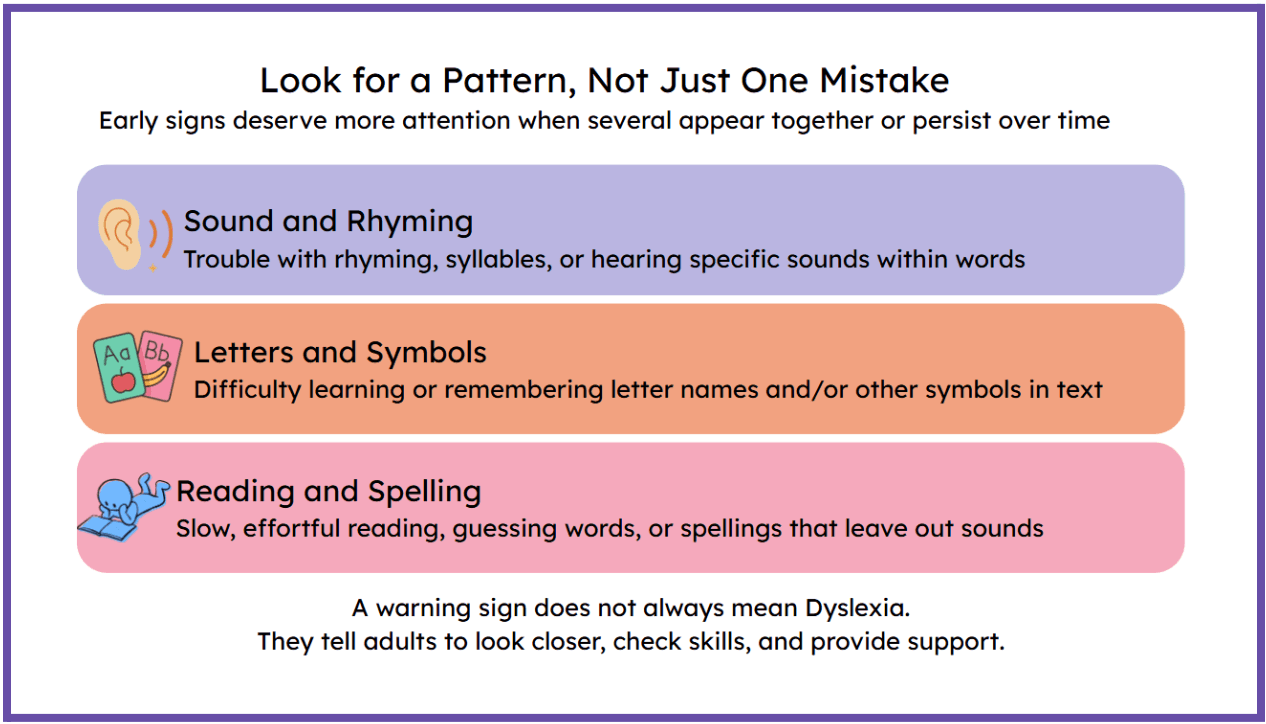
Look for a pattern, not one mistake. A warning sign does not prove that a child has dyslexia. It tells adults to check the child's skills, provide support, and watch progress closely.
A child may tell rich stories, solve hard problems, and understand what is read aloud, yet still have unusual trouble learning to read and spell. That gap can be an early clue. Dyslexia affects how accurately and quickly a person reads written words and can also impact how well they spell. It is not a sign of low intelligence, laziness, or weak motivation. [1, 2]
Dyslexia looks different from one child to another. No single trait can confirm it. The clearest concern is a group of reading and language difficulties that lasts over time, gets in the way of learning, or continues even when the child receives strong instruction. [1, 3]
Why early signs matter
Children do not need to wait until they have failed for several years before adults act. Skills linked to later reading can be checked before or soon after formal reading instruction begins. These include knowing letter names, noticing the sound parts in spoken words, connecting sounds to letters, rhyming skills, and quickly naming familiar items. Strong research reviews and newer long-term studies show that these skills can help identify children who may need more support. [3-6]
Early action matters because younger children often make stronger gains from well-designed reading support than children who begin the same kind of support later. Still, help can make a difference at any age. [1, 10, 11]
Signs before formal reading instruction
In preschool and kindergarten, adults are looking for risk signs, not trying to diagnose dyslexia from a checklist. These signs deserve more attention when several appear together or when dyslexia or serious reading difficulty runs in the family. Dyslexia often occurs in families, and children with a family history are more likely to show early language and reading-related struggles. [2-4]
Trouble noticing rhyme and sound patterns. A child may not hear that cat and hat rhyme, may struggle to clap the syllables in a word such as picnic, or may have trouble saying the first sound of words.
Difficulty learning letter names or sounds. Even with repeated practice, the child may forget a letter's name, confuse it with several others, or have trouble remembering the sound linked to it.
A history of speech or language difficulty. The child may have started talking later than expected, may often search for a familiar word, or may have lasting trouble saying longer words. These signs can have many causes, but they raise concern when they appear with early literacy difficulties.
Slow naming of familiar things. The child may know colors, common objects, or letters but take much longer than peers to name a row of them. This is a task for trained screeners, not a home test.
Family history. A parent, sibling, or close relative may have dyslexia or may remember reading and spelling as unusually hard. Family history is not proof, but it is useful information to share with a teacher or doctor.
Example: Maya enjoys stories and can explain exactly why a character is upset. When asked which word starts like moon: map or sun, she guesses. After months of classroom practice, she also remembers only a few letter sounds. Her strong comprehension skills do not cancel out the concern. The pattern suggests that her early reading skills should be watched closely.
Signs in kindergarten through second grade
Once children begin formal reading instruction, the warning signs become easier to see. Adults should compare a child's progress with what has been taught, not simply with age or effort. [1, 3, 8]
Sounding out words is unusually hard. The child may struggle to blend the sounds /m/ /a/ /p/ into map, or may be unable to read a new short word after learning its letter sounds.
Reading is slow, effortful, or inaccurate. The child may pause at many words, lose the line, reread often, or need far more time than their classmates.
The child guesses instead of reading through the word. A child may see the word horse and say house because both begin with h, or use a picture to guess without checking all the letters.
Common words do not become easy to recognize. Words the child has seen many times may still be read differently from one page to the next.
Spelling does not show all the sounds in a word. The child might write ship as sip or shp, or spell the same word several different ways in one piece of writing.
Reading and comprehension look very different. The child may understand an age-appropriate story when someone else reads it but struggle to read a much simpler text alone.
Progress stays weak despite strong instruction and extra practice. The child may work hard and attend support lessons but continue to fall behind in word reading or spelling.
Example: Eli can read a practiced book from memory, but he cannot read a new word such as sunset by working through its parts. He guesses sunny, stops, and looks at the picture. His teacher also sees that his spelling leaves out sounds. Together, these observations are more useful than either mistake alone.
Signs in third grade and beyond
Some children are identified later. They may have memorized many early words, used strong language skills to hide a struggle, or managed until school texts became longer and harder. Recent long-term research confirms that reading risk can become more visible as demands grow. [6]
Reading remains much slower than expected. The child can read the words, but the work takes so much effort that meaning, pace, or expression suffers.
Long or unfamiliar words are hard to read. Words such as information, confident, or transportation may be skipped, shortened, or guessed.
Spelling remains weak. The student may avoid words they can say easily because they do not know how to spell them.
Written work does not match spoken ideas. The student may explain a complex idea in conversation but write short, simple sentences to avoid spelling and word-reading demands.
Reading causes fatigue, worry, or avoidance. The student may dread reading aloud, take far longer on homework, or say that reading is boring when it feels frustrating.
Learning is easier through listening. The student may understand a lesson, audiobook, or discussion well but struggle to gain the same information from print.
Screening is not the same as an evaluation
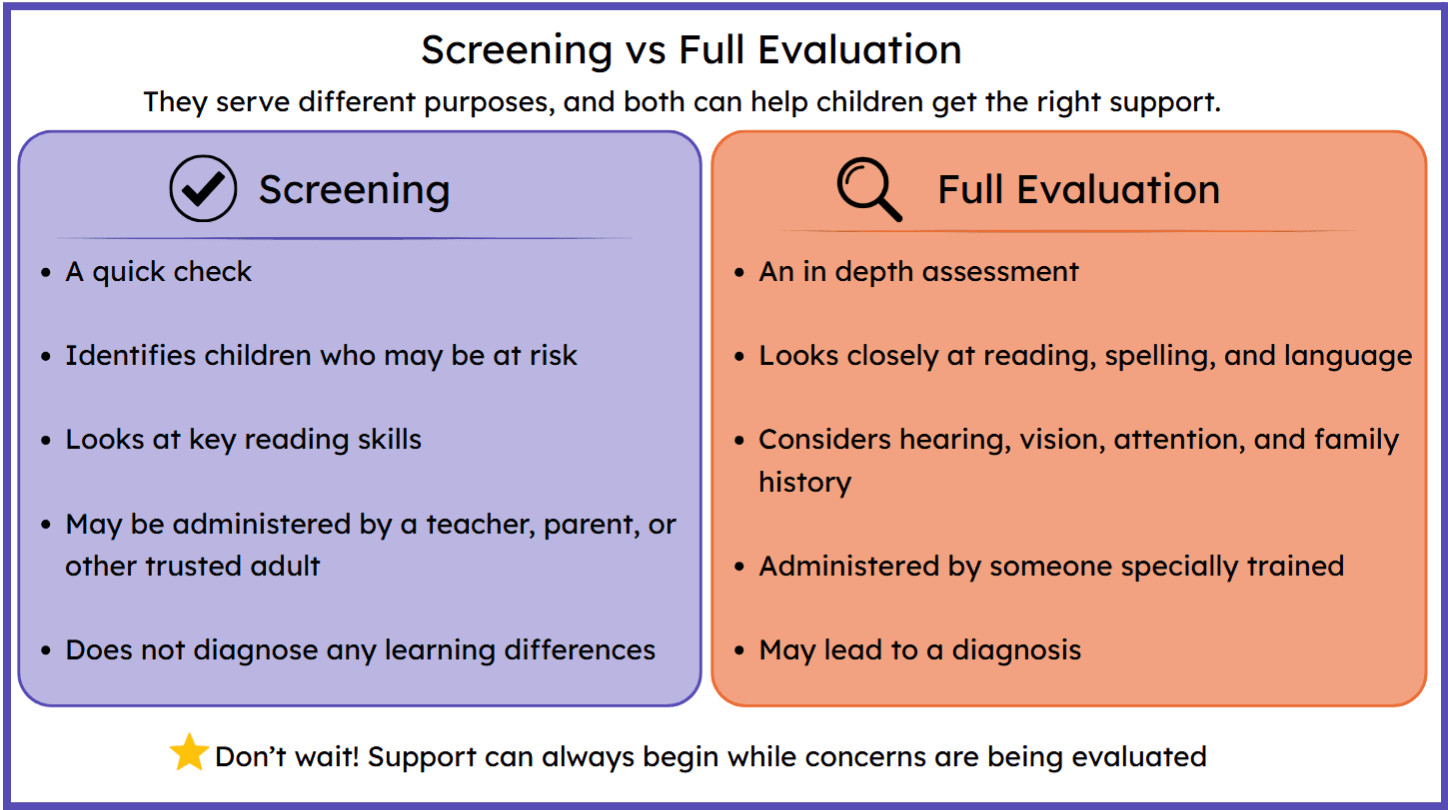
A screening is a short check used to find children who may be at risk. It does not diagnose dyslexia. A full evaluation looks more closely at reading words, spelling, reading speed and accuracy, spoken language, instruction, and the child's learning history. It should also consider hearing, vision, attention, and language exposure so that adults do not mistake another need for dyslexia - or miss dyslexia because another need is present. [3, 9]
For children who use more than one language, the team should consider how long and how well the child has been taught in each language. Learning two languages does not cause dyslexia. The key question is whether the child's difficulty is greater and more persistent than expected for children with similar language experience. [1, 2]
Action steps for parents
Write down specific examples. Save a few reading or spelling samples. Note what the child was asked to do, what help was given, and what happened. Also record strengths, such as strong listening, storytelling, problem-solving, or knowledge.
Ask the teacher for skill-by-skill information. Instead of asking only, "Is my child behind?" ask about letter names and sounds, hearing sounds in words, reading unfamiliar words, reading speed and accuracy, spelling, and growth since the last check in.
Ask what support is being provided. Find out what is taught, how often the child receives extra instruction, how large the group is, and how progress will be measured. Do not wait for a final label before the child receives help.
Request a full evaluation when concerns persist. Ask the school, in writing, how to begin its evaluation process. Share any family history and examples you collected. A pediatrician can check hearing, vision, and general development and can refer the child to a reading, psychology, or speech-language professional when needed.
Keep reading enjoyable at home. Read aloud and use audiobooks so the child can keep building knowledge and vocabulary. Brief sound and word games can support school instruction, but home practice should not become a nightly test or replace skilled teaching.
Protect the child's confidence. Say clearly that reading difficulty is not a measure of intelligence. Name the child's strengths and praise useful actions, such as asking for help, trying a strategy, or noticing an error.
Action steps for teachers
Use reliable screening measures. Check all students at the start of the year and again throughout the year. In the earliest grades, include letter knowledge, awareness of speech sounds, word reading, rhyming, and reading accuracy. [8, 9]
Look beneath the total reading score. A child may have good listening and vocabulary but weak word reading. Review the separate skills so that one strength does not hide a serious need.
Teach the missing skill directly. Use a clear, planned sequence that links spoken sounds with letters, shows children how to read through unfamiliar words, and includes guided practice in reading and spelling. Students at risk often need smaller groups, more practice, and immediate feedback. [8, 9, 11]
Track progress often. For students receiving added support, use brief measures at regular intervals. Change the teaching plan to meet the child's needs. [9]
Share concrete evidence with families. Bring examples, scores over time, and notes about which prompts help. Say, "She can identify the first sound, but she cannot yet blend three sounds into a word," rather than, "She is a slow reader."
Refer for evaluation when the pattern is serious or persistent. Extra instruction and an evaluation can happen at the same time. A child should not have to complete years of intervention before the school considers a fuller evaluation. [3, 10]
A final word
Noticing early signs is not about placing a limit on a child. It is about replacing guesswork with useful information. When parents and teachers share specific observations, check the right skills, begin strong instruction, and follow the child's progress, they create a faster path to support and a better chance for the child to see reading struggles as a learning need, not a personal failure.
Sources
1. International Dyslexia Association. (2025). 2025 definition of dyslexia and explanation. View source
2. Peterson, R. L., & Pennington, B. F. (2012). Developmental dyslexia. The Lancet, 379, 1997-2007. View source
3. Sanfilippo, J., Ness, M., Petscher, Y., Rappaport, L., Zuckerman, B., & Gaab, N. (2020). Reintroducing dyslexia: Early identification and implications for pediatric practice. Pediatrics, 146(1), e20193046. View source
4. Snowling, M. J., & Melby-Lervag, M. (2016). Oral language deficits in familial dyslexia: A meta-analysis and review. Psychological Bulletin, 142(5), 498-545. View source
5. National Early Literacy Panel. (2008). Developing early literacy: Report of the National Early Literacy Panel. National Institute for Literacy. View source
6. Yinon, R., Tal, D., Shaul-Millear, S., Kanat-Maymon, Y., Katzir, T., & Karni, A. (2026). Kindergarten screening for early (grade 1) and late-emerging (grade 4) dyslexia risk. JAMA Network Open, 9(3), e263036. View source
7. Treiman, R., Gordon, J., Boada, R., Peterson, R. L., & Pennington, B. F. (2014). Statistical learning, letter reversals, and reading. Scientific Studies of Reading, 18(6), 383-394. View source
8. Foorman, B., and colleagues. (2016). Foundational skills to support reading for understanding in kindergarten through third grade. Institute of Education Sciences. View source
9. Gersten, R., and colleagues. (2009). Assisting students struggling with reading: Response to intervention and multi-tier intervention in the primary grades. Institute of Education Sciences. View source
10. Lovett, M. W., Frijters, J. C., Wolf, M., Steinbach, K. A., Sevcik, R. A., & Morris, R. D. (2017). Early intervention for children at risk for reading disabilities. Journal of Educational Psychology, 109(7), 889-914. View source
11. Galuschka, K., Ise, E., Krick, K., & Schulte-Korne, G. (2014). Effectiveness of treatment approaches for children and adolescents with reading disabilities: A meta-analysis of randomized controlled trials. PLOS ONE, 9(2), e89900. View source
BrainScience Works Literacy
Build stronger readers, step by step.


About the Author
Taylor Hovish
Taylor comes to us with over a decade of experience in special education and school administration. She holds a graduate degree from Harvard University where she conducted research on children's understanding of various teaching techniques. She has presented at the American Educational Research Association, facilitated workshops at Learning and the Brain conferences, been published in 2e Magazine, and most recently, authored a children’s book in the “A Kid’s Book About…” series. She is passionate about community service and has extensive volunteer experience as a Professor at Mount Tamalpais College at San Quentin and as a Court Appointed Special Advocate for foster youth. Taylor is excited to bring her expertise and passion for strengths-based learning to BrainScience Works!