Back to Blog
How advanced abilities and real learning needs can grow side by side.
A child may explain black holes in surprising detail, then struggle to read a short science paragraph. Another may solve challenging math problems in their head but have great difficulty writing the steps. These patterns can confuse adults because the child may look far ahead in one moment and far behind in the next.
The pattern is possible. Giftedness does not keep a child from having a learning disability. A learning disability does not limit intelligence or talent. Researchers often call a student who is gifted and also has a disability a twice-exceptional learner. This is a useful description, but it does not tell us exactly what any one child will need. [1, 3]
What do giftedness and learning disability mean?
Giftedness is not one single kind of ability. A child may show unusually high ability or potential in language, mathematics, reasoning, creativity, the arts, leadership, or another area. The child is compared with others of a similar age, experience, or environment. Definitions and school rules vary, so one program may identify a child as gifted where another program does not. [1]
A learning disability is a lasting difficulty with one area of learning. It may affect reading, writing, spelling, or math. It is not the same as low intelligence, low effort, or weak teaching. A full evaluation asks whether the problem is real and lasts over time. It also looks at how the problem affects learning, what teaching the child has received, and whether something else better explains their struggles. [3-5]
A child can meet both descriptions. The key question is not whether the two labels seem to conflict. It is whether the facts show high ability in one or more areas while also showing a disability that acts as a barrier in another area.
What is asynchronous development?
Asynchronous development means that parts of a child's growth are moving at different rates. The term has long been used in gifted education. It can describe a child whose advanced thinking is out of step with other skills or with what the child can produce. [2]
For example, an eight-year-old may reason about fairness like a much older student. The same child may react to disappointment like an eight-year-old. That does not prove an emotional delay. It may be typical behavior for that age beside unusually advanced thought. A child may also have ideas that are far beyond their handwriting, spelling, planning, or reading skills.
Asynchrony is a description, not a diagnosis. All children grow at uneven rates to some degree. Research does not show one gifted profile that fits every child. A major review found that gifted children had stronger skills than other children in some areas. In many areas, their skills were much the same. Gifted children also differed widely from one another. [7] Adults should use the idea of asynchrony to become curious, not to make assumptions.
Why can both sides be easy to miss?
Strengths can mask the difficulty. A child with deep word knowledge, a strong memory for facts, or good reasoning may guess words from context. The child may avoid hard tasks or use extra time to keep grades near average. The child may not look far enough behind to cause concern, even when reading or writing takes exhausting effort.
The difficulty can hide the strength. Slow reading, weak spelling, limited written output, or trouble completing timed work can lower classroom grades and broad test scores. Adults may see only the unfinished work and miss the child's advanced ideas, problem solving, or knowledge.
Research supports this masking problem, but it also gives a warning. One study combined the results of 15 earlier studies. Gifted learners with learning disabilities scored lower than gifted peers on one total intelligence score. They also scored lower on some tasks that require holding facts in mind or working fast. Yet no score pattern fits every child. [6] Other reviews have found that studies use very different rules to define and find these learners. [3, 4, 8, 9]
A large gap between two test scores can be worth exploring, but it is not proof of a disability. One national study found that common gap rules wrongly marked many gifted students as possibly learning disabled. [5] A sound evaluation must show that a real skill is impaired. It is not enough for that skill to be lower than the child's strongest skill.
What might the pattern look like?
Example: Jordan is nine and loves engineering. Jordan can explain why one bridge design will hold more weight than another. Jordan can also improve a model after it fails. During reading, Jordan guesses at new words and reads slowly. Little is remembered because so much effort goes into figuring out the print. Written answers are short and simple, even when spoken answers are rich. Adults might call Jordan careless because the schoolwork does not match the conversation. A better response is to look into both the strong reasoning skills and the reading difficulty.
Other clues may include a large gap between spoken and written answers. A child may have deep ideas but weak basic skills. Work may improve when there is no time limit. High grades may also take far more effort than adults can see. Some students show worry or low confidence after years of being told they are capable but are not showing it. A research review found strengths and struggles in drive, self-belief, coping, and relationships. Frustration about school appeared often. [8]
None of these signs proves giftedness or a disability. Boredom can lower effort without causing a learning disability. Anxiety, missed instruction, language background, attention, sleep, or other factors can also affect performance. Adults should look for a stable pattern across time, settings, and ways of responding.
A good evaluation shows a profile, not just a label
A useful evaluation asks two questions at the same time: Where does this child show unusually strong skill or promise? Where does one skill create a real barrier?
The team should use several sources. These may include one-to-one tests, classwork, growth during lessons, notes from adults, and the child's own account. Reviews of this field call for a full evaluation that looks closely at the individual child. [3, 5, 9]
It also helps to compare different ways of showing knowledge. Can the child explain an idea aloud but not in writing? Solve a problem with objects but not read the directions? Learn complex content through listening while struggling with a much easier printed passage? These comparisons do not diagnose a disability, but they show where adults should look more closely.
Average grades should not end the conversation when they depend on unusual effort, heavy family help, memorization, or avoidance. At the same time, a high score in one area should not be used to excuse a serious weakness in another. The goal is to understand how the child learns, not to force every result into one total score.
Support both the strength and the need
Children should not have to earn access to challenging ideas by first eliminating every area of difficulty. They need chances to develop their talents while receiving direct teaching and useful supports for the skills that are hard. A strength is not an escape from instruction, and intervention should not take over the child's entire school identity.
This may mean advanced science paired with intervention reading pull out. It could mean complex talks paired with support for writing, or challenging math with less focus on speed. Audiobooks, speech-to-text tools, extra time, or spoken answers can all give greater access. The child can still keep learning the skill itself.
A case study looked at students in one school built for these learners. Growth was linked with feeling safe, strong ties with adults, enough time, respect for uneven growth, and steady focus on talents. While this was one case study in one setting and it cannot prove that one program will work for every learner, it does show why support should make room for ability as well as difficulty. [10]
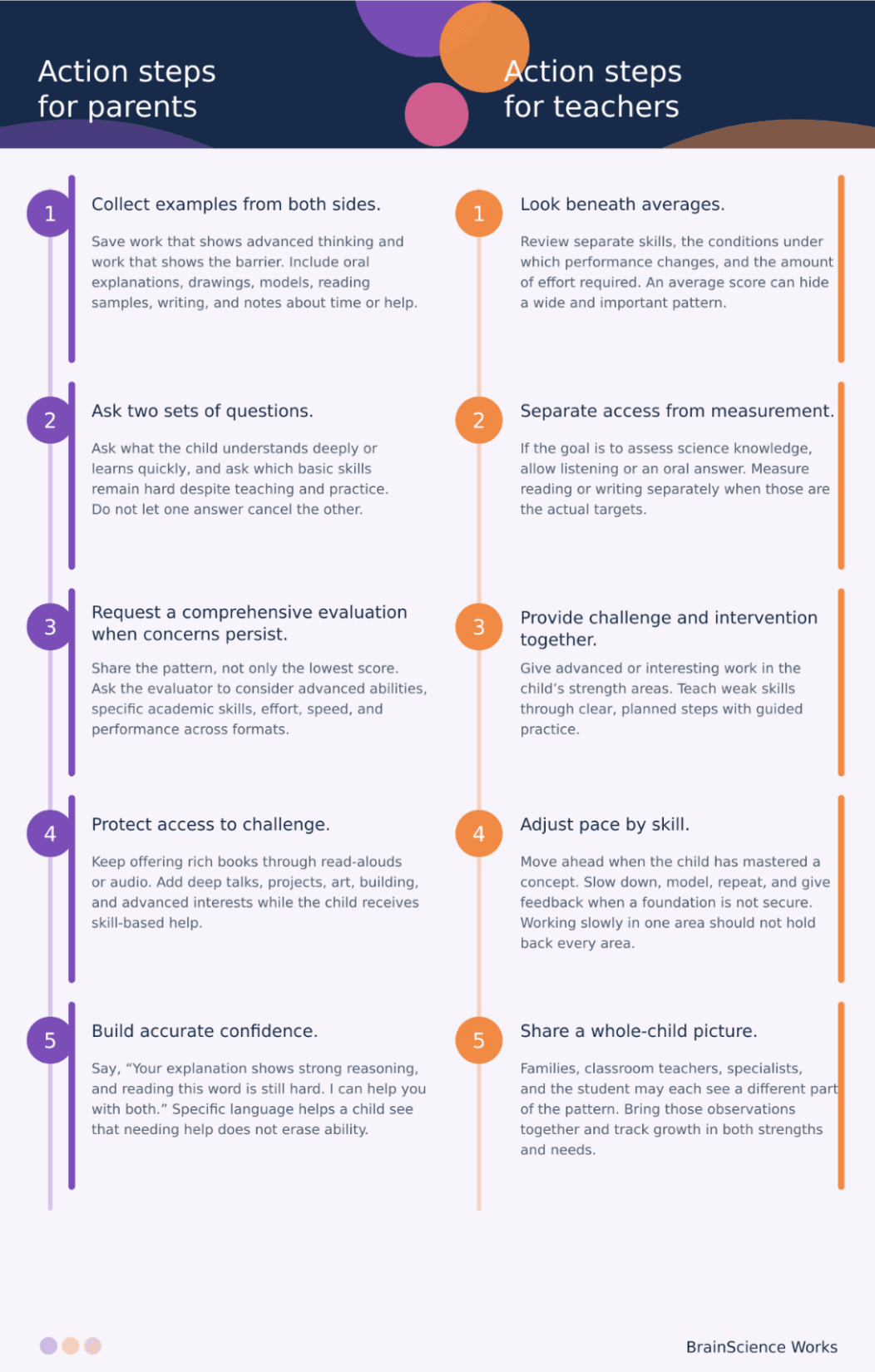
How BrainScience Works supports uneven learners
BrainScience Works lessons let children work at their own pace. A learner can pause, repeat a step, and practice before moving on. A child who is ready can continue. The same lesson steps make the process familiar. More attention can then go to the letter, word, sound, spelling pattern, or meaning being learned.
The clay work also gives students another way to enter the lesson. Children build letters and words, study what they made, write the word, and use clay to model what the word means. A child who thinks in pictures, speaks well, creates, or solves problems can use those strengths. The printed word becomes easier to see and study. The model then leads back to reading, spelling, writing, and meaning; it does not replace them. This mix reflects the wider evidence for direct teaching, clear links, guided practice, and feedback. [11, 12]
Small, visible successes can also help rebuild confidence. The learner can point to a finished model, explain an idea, and see the next step. Its value is a clear path, enough time, and more than one way to link strengths with skills that need support.
A final word
An uneven learner is not a contradiction. A child can need advanced ideas and careful teaching of basic skills on the same day. Adults can stop asking whether the child is gifted or struggling. They can ask how both are true. The support can then become more accurate, respectful, and hopeful.
Sources
1. National Association for Gifted Children. (2019). Key considerations in identifying and supporting gifted and talented learners.
2. Silverman, L. K. (1997). The construct of asynchronous development. Peabody Journal of Education, 72(3-4), 36-58.
3. Foley Nicpon, M., Allmon, A., Sieck, B., & Stinson, R. D. (2011). Empirical investigation of twice-exceptionality: Where have we been and where are we going? Gifted Child Quarterly, 55(1), 3-17.
4. Lovett, B. J., & Sparks, R. L. (2013). The identification and performance of gifted students with learning disability diagnoses: A quantitative synthesis. Journal of Learning Disabilities, 46(4), 304-316.
5. Maddocks, D. L. S. (2018). The identification of students who are gifted and have a learning disability: A comparison of different diagnostic criteria. Gifted Child Quarterly, 62(2), 175-192.
6. Atmaca, F., & Baloglu, M. (2022). The two sides of cognitive masking: A three-level Bayesian meta-analysis on twice-exceptionality. Gifted Child Quarterly, 66(4), 277-295.
7. Bucaille, A., Jarry, C., Allard, J., Brochard, S., Peudenier, S., & Roy, A. (2022). Neuropsychological profile of intellectually gifted children: A systematic review. Journal of the International Neuropsychological Society, 28(4), 424-440.
8. Beckmann, E., & Minnaert, A. (2018). Non-cognitive characteristics of gifted students with learning disabilities: An in-depth systematic review. Frontiers in Psychology, 9, 504.
9. Rizzo, L., Pinnelli, S., & Minnaert, A. (2025). Twice-exceptional students: A systematic review to outline the distinctive characteristics through a multidimensional lens. Frontiers in Education, 10, 1696805.
10. Baum, S. M., Schader, R. M., & Hebert, T. P. (2014). Through a different lens: Reflecting on a strengths-based, talent-focused approach for twice-exceptional learners. Gifted Child Quarterly, 58(4), 311-327.
11. National Academies of Sciences, Engineering, and Medicine. (2018). How people learn II: Learners, contexts, and cultures. The National Academies Press.
12. Foorman, B., and colleagues. (2016). Foundational skills to support reading for understanding in kindergarten through third grade. Institute of Education Sciences.
BrainScience Works Literacy
Build stronger readers, step by step.


About the Author
Shama Hinard
Shama brings 28 years of experience in classroom teaching and school administration to her role at BrainScience Works. Throughout her career, she has been deeply committed to supporting neurodivergent learners and helping each student discover their unique path to success. Over the years, she has led professional development workshops with Learning and the Brain and played a leadership role in the LD school community – organizing retreats, mentoring educators, and advising schools on how to launch effective dyslexia programs.