Back to Blog
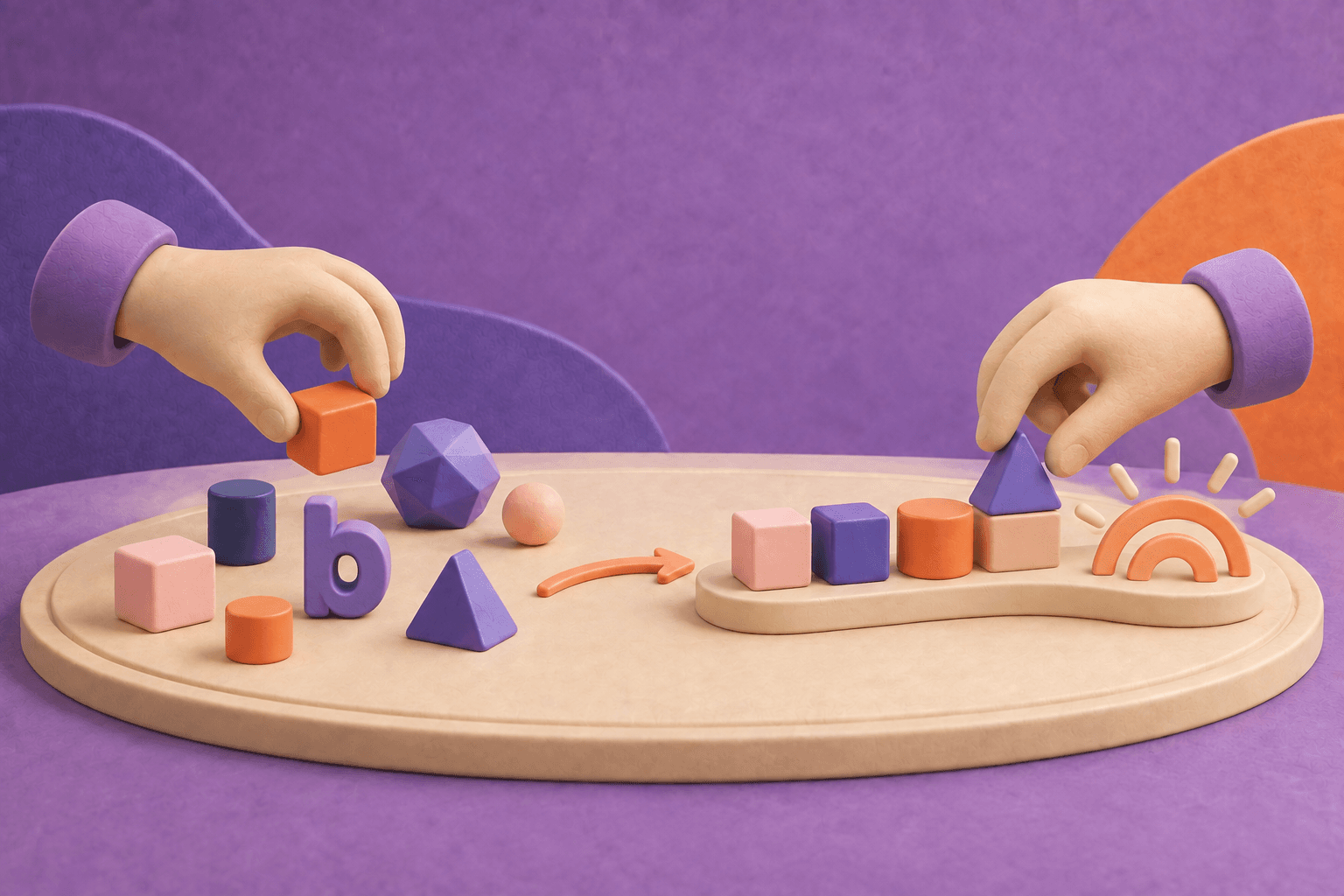
Hands-on learning can make ideas easier to understand and remember when the action is closely connected to the skill being taught. Touching, moving, seeing, saying, and making are useful when they help a learner notice an important feature, explain an idea, or recall it later.
A child can hear an explanation and still have trouble holding onto it. Give the child letters to arrange, a model to build, or an idea to show with their hands, and the lesson may become more concrete. The learner is no longer only receiving information. The learner is experiencing it.
That difference can matter, but hands-on learning is not magic. A busy activity can be memorable without teaching the intended idea. Strong lessons use materials and movement for a clear purpose, join them with direct teaching, and return to the knowledge again over time.
What does multisensory learning mean?
Multisensory learning uses information from more than one sense. A student might see a letter, hear its name, say it aloud, trace or build its shape, and then write it. Hands-on learning adds active use of the body or an object. Manipulatives are objects a learner can move or change to represent an idea.
These terms overlap, but they do not all describe the same lesson. Watching a colorful video uses sight and sound, yet it may still be passive. Building a word from letters is hands-on, but it only supports reading if the learner also attends to the letters, sounds, order, and meaning.
The brain normally combines information from different senses. A major research review found that well-matched information across senses can improve some kinds of learning, especially when the signals support the same judgment or pattern. [2]
More senses do not automatically mean more learning
It is common to hear that one child is a visual learner, another is an auditory learner, and a third is a hands-on learner. People do have preferences. However, a major review found no strong evidence that teaching each student only through a preferred sense improves learning. [3]
The better question is, “Which forms of information fit this idea?” A map should be seen. A new speech sound should be heard and produced. A letter should be seen, named, linked with sound, and formed. The method should match the content, not a label placed on the child.
Extra sound, color, movement, or decoration can also compete for attention.
Research on learning through the body stresses that movement helps most when it is meaningfully tied to the task.
The goal is not maximum stimulation. It is a clear connection between what the learner does and what the learner needs to know. [5]
How hands-on work can support memory
Memory is not a perfect recording of a lesson. When people remember, they rebuild knowledge using connections and cues. The cues available during learning and later recall can shape what a person is able to bring back. [1]
A purposeful action can create useful cues. If a child says the name for the letter ‘m’ while shaping an m and then finds that letter in a word, the shape, sound, movement, and printed example all point toward the same learning goal. This does not create separate copies of the lesson in separate “memory banks.” It creates a more connected experience that can give the learner several relevant ways to reconstruct the idea.
Hands-on work can also require a student to generate an answer. Choosing letters, placing them in order, building a model, and explaining it demand more thought than simply looking at a finished example. In controlled studies, creating visual explanations helped learners notice missing parts, show relationships, and improve understanding. Those studies support the value of making an idea visible and checking whether it makes sense. [6]
Manipulatives can make abstract ideas visible
Symbols can feel empty when a learner does not yet understand what they stand for. A movable object can give the learner something to inspect, compare, arrange, and change. This can reduce the need to hold every part of a problem in mind at once.
The strongest broad evidence about manipulatives comes from mathematics. A meta-analysis of 55 studies, including more than 7,000 learners, found small to moderate advantages for concrete manipulatives over abstract symbols alone. Results changed with the lesson design and the amount of teacher guidance. [4]
That finding gives us a useful principle, not a promise about every subject or material. The object must stand for the right idea. The teacher must name the connection. The student must move from the object back to the letter, word, number, or concept it represents. Otherwise, the material can become the focus instead of the learning.
What the literacy research shows
Research with young children gives more direct evidence for purposeful touch and hand movement in letter learning.
In one controlled study, children who explored letter shapes by sight and touch made greater gains in some early reading skills than children who received similar sound-based teaching without the touch component. [7]
A later meta-analysis combined 50 experiments on handwriting and visual symbol learning. On average, handwriting practice improved later recognition of letters and other symbols compared with control activities. The size of the advantage varied with the comparison activity, the learning task, and the type of symbol judgment. The authors concluded that the benefit may come partly from learning to notice the important visual features of symbols, not from movement alone. [8]
Federal reading guidance also recommends active word work. Children should connect speech sounds with letters, build and change words, analyze word parts, read the words, and write them. These actions are not side activities. They are ways to practice the knowledge that reading requires. [9]
Words are remembered through connections
Skilled readers do not learn every word as an unrelated picture. Research on word learning shows that lasting word memory depends on connecting the letters in a word with its sounds. Meaning must also become linked to the printed form. [10]
Consider the word under. A child can say it, listen for its sounds, build the letters in the correct order, and read it. The child can then place one clay object under another and explain the relationship. The model does not replace attention to the printed word. It gives the meaning a clear form while the learner returns to the exact spelling.
This kind of lesson joins several useful actions around one target. Seeing the word supports attention to print. Saying and hearing it support sound. Building it requires attention to order. Modeling and explaining support meaning. Writing asks the learner to produce the form again.
An activity is only the beginning of memory
A child may complete a beautiful model and still forget the word next week. Long-term learning requires returning to the knowledge. Large research reviews identify spaced practice and low-stakes recall as especially dependable ways to strengthen memory. Controlled experiments also show that trying to retrieve information can produce better delayed recall than simply studying it again. [11, 12]
After a hands-on lesson, ask the child to read or build the word again later with less help. Mix it with previously learned words. Ask what it means and use it in a new sentence. Return to it the next day and the next week. The material helps create and organize the first experience; recall and practice help make that learning durable.
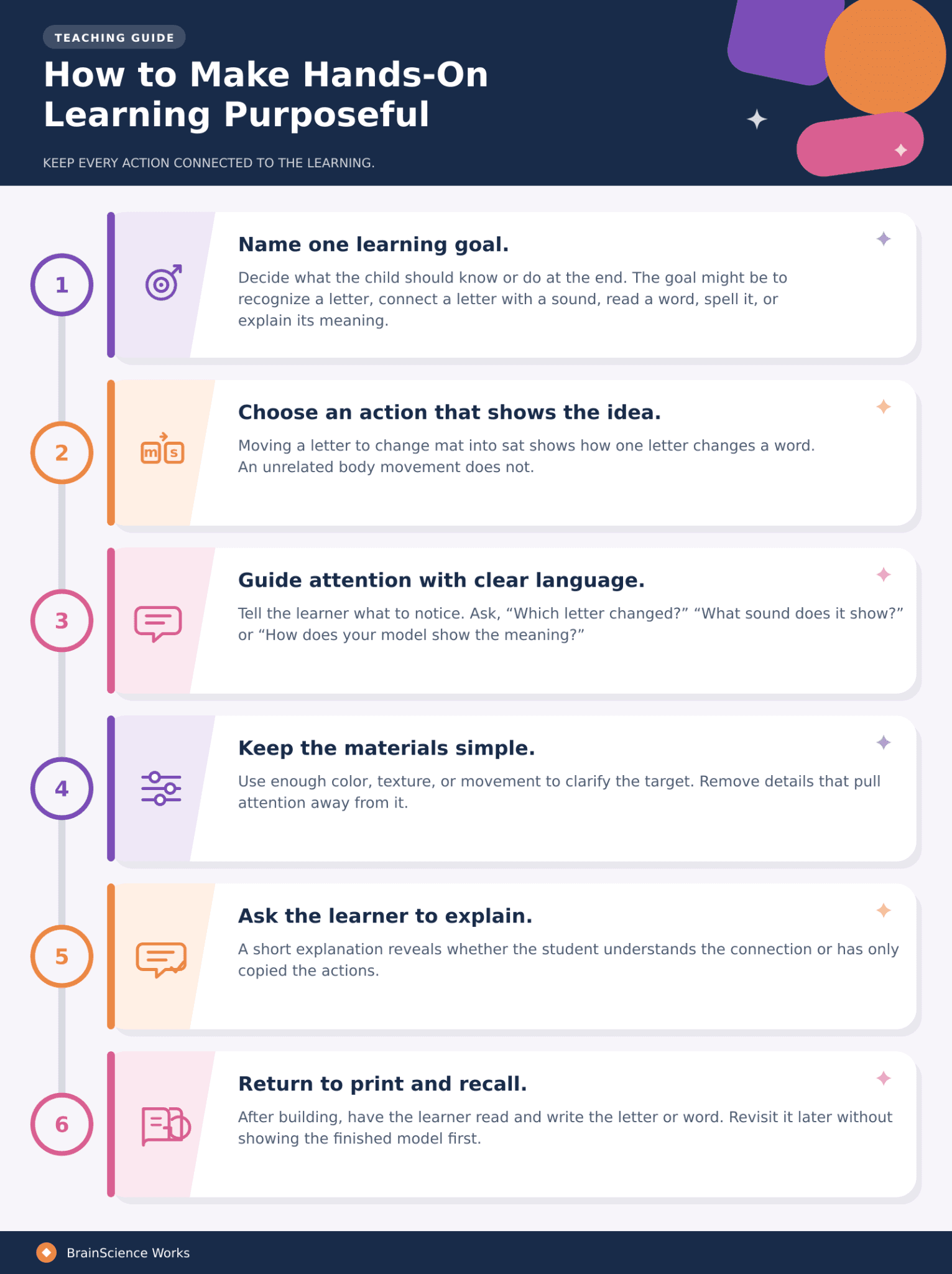
Download our tips for
how to make hands-on learning purposeful
How BrainScience Works puts the research into practice
BrainScience Works uses clay within a clear lesson routine. Students say, build, see, and write letters and words. For word learning, they also explore meaning and use clay to model what the word means.
When a learner makes a letter or word in clay, the hands-on step can slow the task down and make important features easier to inspect. The learner can compare shapes, check letter order, connect the letters with speech sounds, and then produce the form in writing. When the learner models a word such as between, before, or under, an abstract relationship becomes visible and can be explained.
This design reflects several findings from the research: touch and letter formation can support symbol learning; manipulatives work best with guidance; meaningful movement is more useful than movement for its own sake; and words become secure when print, sound, and meaning are connected. Predictable steps also make it easier to focus on the new learning rather than figuring out a new activity each time. [4, 5, 7-10]
A final word
Hands-on learning is most powerful when the hands are serving the mind. A useful material gives an idea a form the learner can examine and change. A useful action directs attention to what matters. Clear teaching explains the connection, and later practice asks the learner to use it again. When those parts work together, learning can become more understandable, more active, and more likely to last.
Sources
- National Academies of Sciences, Engineering, and Medicine. (2018). How People Learn II: Learners, Contexts, and Cultures. The National Academies Press. View source
- Shams, L., & Seitz, A. R. (2008). Benefits of multisensory learning. Trends in Cognitive Sciences, 12(11), 411-417. View source
- Pashler, H., McDaniel, M., Rohrer, D., & Bjork, R. (2008). Learning styles: Concepts and evidence. Psychological Science in the Public Interest, 9(3), 105-119. View source
- Carbonneau, K. J., Marley, S. C., & Selig, J. P. (2013). A meta-analysis of the efficacy of teaching mathematics with concrete manipulatives. Journal of Educational Psychology, 105(2), 380-400. View source
- Skulmowski, A., & Rey, G. D. (2018). Embodied learning: Introducing a taxonomy based on bodily engagement and task integration. Cognitive Research: Principles and Implications, 3, 6. View source
- Bobek, E., & Tversky, B. (2016). Creating visual explanations improves learning. Cognitive Research: Principles and Implications, 1, 27. View source
- Bara, F., Gentaz, E., Colé, P., & Sprenger-Charolles, L. (2004). The visuo-haptic and haptic exploration of letters increases kindergarten children's understanding of the alphabetic principle. Cognitive Development, 19(3), 433-449. View source
- Araújo, S., Domingues, M., & Fernandes, T. (2022). From hand to eye: A meta-analysis of the benefit from handwriting training in visual graph recognition. Educational Psychology Review, 34(3), 1577-1612. View source
- Foorman, B., Beyler, N., Borradaile, K., Coyne, M., Denton, C. A., Dimino, J., Furgeson, J., Hayes, L., Henke, J., Justice, L., Keating, B., Lewis, W., Sattar, S., Streke, A., Wagner, R., & Wissel, S. (2016; revised 2019). Foundational Skills to Support Reading for Understanding in Kindergarten Through 3rd Grade. What Works Clearinghouse, U.S. Department of Education. View source
- Ehri, L. C. (2014). Orthographic mapping in the acquisition of sight word reading, spelling memory, and vocabulary learning. Scientific Studies of Reading, 18(1), 5-21. View source
- Dunlosky, J., Rawson, K. A., Marsh, E. J., Nathan, M. J., & Willingham, D. T. (2013). Improving students' learning with effective learning techniques: Promising directions from cognitive and educational psychology. Psychological Science in the Public Interest, 14(1), 4-58. View source
- Roediger, H. L., & Karpicke, J. D. (2006). Test-enhanced learning: Taking memory tests improves long-term retention. Psychological Science, 17(3), 249-255. View source
BrainScience Works Literacy
Build stronger readers, step by step.


About the Author
Taylor Hovish
Taylor comes to us with over a decade of experience in special education and school administration. She holds a graduate degree from Harvard University where she conducted research on children's understanding of various teaching techniques. She has presented at the American Educational Research Association, facilitated workshops at Learning and the Brain conferences, been published in 2e Magazine, and most recently, authored a children’s book in the “A Kid’s Book About…” series. She is passionate about community service and has extensive volunteer experience as a Professor at Mount Tamalpais College at San Quentin and as a Court Appointed Special Advocate for foster youth. Taylor is excited to bring her expertise and passion for strengths-based learning to BrainScience Works!