Back to Blog
Strong literacy teaching is not built around one method or one part of reading. It links word reading with language and meaning. It also includes writing, discussion, practice, and support that changes as students grow.
Educators make dozens of literacy decisions each day. Should this child work on sounds or meaning? Should the class discuss the text or write about it? How can one teacher help a student who is still learning letter sounds while another student is ready for a complex chapter book? These are not small questions. They shape what children practice and how they see themselves as learners.
Research does not offer one script for every classroom. It does offer useful principles. Children need clear teaching in how print represents spoken language. They also need vocabulary, knowledge, fluent reading, writing, and chances to explain ideas. Teachers need good information about each learner and enough time to respond to it. [1-4]
1. Is literacy instruction mostly about phonics or comprehension?
It is about both, but each part has its own job. Beginning readers need to learn that letters and letter groups represent sounds. They need direct practice blending those sounds into words. They also need to read words correctly and spell them. Large research reviews and federal guidance support planned teaching in sound awareness, letter-sound relationships, decoding, spelling, and daily reading of connected text. [1-3]
Accurate word reading is necessary, but it is not the finish line. A child can pronounce every word in "The habitat became too dry for the frogs" and still miss the meaning of habitat or the cause-and-effect relationship. Understanding also depends on vocabulary, background knowledge, sentence meaning, reasoning, and the ability to notice when something does not make sense. [4, 12]
The practical answer is not to divide the school day into a "skills side" and a "meaning side" that never meet. A lesson can teach children to read and spell a word, use it in a sentence, discuss what it means, and read it again in a short text. Word reading gives the child access to print. Language and knowledge help the child understand what that print means.
2. How do reading, writing, speaking, and listening fit together?
The four parts of literacy support one another, but they are not interchangeable. Listening can give a child access to ideas that are still too hard to read alone. Speaking can reveal strong understanding that weak spelling hides. Reading provides models of words, sentences, and text. Writing requires the learner to choose language and put ideas into a visible form.
A meta-analysis found that writing about what students read improved their grasp of the material. It also found that teaching writing helped reading comprehension, fluency, and word reading. [5]
Talk matters too. A meta-analysis of classroom discussion found that several discussion approaches improved student talk and understanding of text, although effects varied by method and measure. Questions that ask students to explain, connect evidence, or compare ideas do more literacy work than questions that only ask for one remembered fact. [6]
Consider the word migration. Students can listen to an explanation, say the word, read it in a passage, discuss why an animal might migrate, and write a sentence using it. Each response gives the teacher different evidence. Together, they help connect the word's sound, spelling, meaning, and use.
3. How can one teacher meet a wide range of needs?
Start by looking beneath a total reading score. One student may read words accurately but understand little. Another may explain complex ideas aloud but struggle to read a short new word. A third may read slowly because the words are not yet automatic. These students do not need the same next lesson.
A useful plan names the skill and checks it directly. It teaches the skill in clear steps and watches the student's response. Federal guidance recommends screening and small-group help for students who need more support. It also calls for regular progress checks. If growth is weak, adults should adjust the time, group size, practice, or teaching approach instead of repeating the same lesson. [8]
Research with first graders also shows why matching teaching to the learner matters. In a controlled study, teachers used student vocabulary and reading data to adjust the amount and type of literacy teaching. Students in the individualized program made stronger reading gains on average. This does not mean every child needs a separate curriculum. It supports using evidence to vary pace, grouping, and practice. [7]
Students with serious word-reading or spelling difficulties need more than extra exposure. Strong support is direct, carefully sequenced, and connected to reading and spelling practice. It should begin when the need is clear, not after years of failure. [2, 8, 9]
Don't wait for students to fail.
Support should begin as soon as the need is clear.
4. What keeps students engaged…and is engagement enough?
Engagement is not a decoration added after the lesson. Students learn more from practice they can participate in, understand, and complete with the right amount of effort. Clear goals, useful choices, interesting content, active responses, and visible progress can all support engagement. A predictable routine can also reduce the energy spent figuring out what to do next.
A large research review found that programs designed to build reading motivation produced gains in both motivation and reading achievement. The careful conclusion is that motivation can directly support learning. [10]
Success also matters. Work that is far too easy can feel empty, while work that is too challenging can invite avoidance. Engagement is more likely to last when students understand the goal, receive feedback, and can see that their effort led to a real change in what they can do or what they understand. [4, 12]
5. How can I protect time for small groups without lowering quality?
Small-group time lets a teacher listen closely, give immediate feedback, and provide more practice on a specific need. Federal guidance recommends added small-group instruction for students at risk and regular checks to see whether it is working. That time is valuable, but it only works when the rest of the class also has worthwhile learning to do. [8]
Independent work should not mean leaving a child alone with a new or fragile skill. Students first need a clear routine, materials they can manage, and a task at the right level. They also need a way to respond and receive feedback. Useful choices might include rereading a familiar text, sorting words by a taught pattern, building and writing known words, listening to language and responding aloud, or completing a guided lesson.
Digital teaching can help, but the device itself is not the active ingredient. A best-evidence review of 20 studies involving about 7,000 elementary students found a positive average effect for reading technology used with struggling readers. While results differed widely across programs, the strongest results came from approaches closely tied to the reading curriculum and supported by small-group interaction. [11]
The classroom test is simple: Can students begin without repeated teacher directions? Does the activity give real teaching or practice? Is the response visible enough to review? Can the teacher tell who needs help? When the answer is yes, independent work can protect small-group time without turning the rest of the room into unsupervised seatwork.
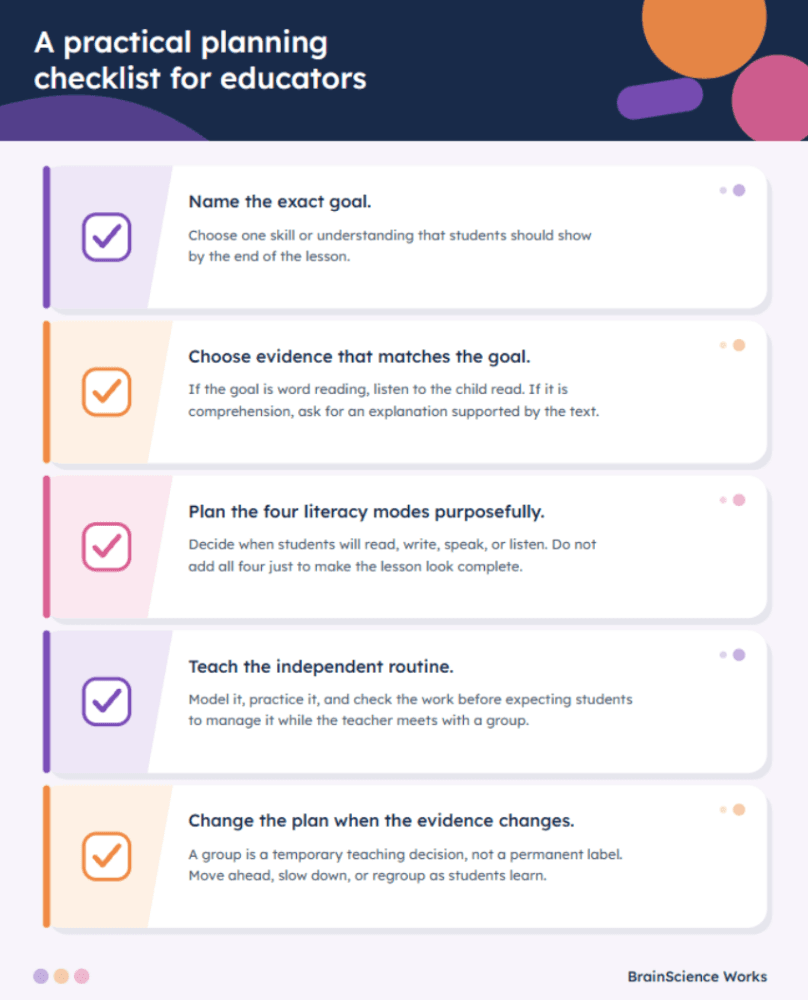
How BrainScience Works addresses these classroom questions
BrainScience Works is designed as a supplemental literacy program that students can use after the teacher sets up the lesson and materials. A digital teacher provides explicit instruction through a predictable sequence. Students can move through that sequence at their own pace, pausing or repeating when needed. Because the teaching is built into the program, classroom educators have more space to meet with a small group or support other learners while still monitoring progress.
Students do more than watch a screen. They speak and listen to letters and words, build them in clay, look closely at what they made, read, and write in a workbook. Some activities ask them to model and explain what words mean. In this way, each lesson brings reading, writing, speaking, and listening into one focused routine while keeping the target concept clear.
The clay and the predictable steps are also designed to keep students actively involved. A learner produces something visible, explains it, and returns to print instead of only clicking through answers. The finished letter, word, model, and written response give both the student and teacher concrete signs of progress.
A final word
Teachers should not have to choose between strong foundational skills and rich language, between engagement and rigor, or between independent learning and personal support. The strongest literacy classroom connects these needs. Students receive clear teaching, meaningful practice, and the right amount of help. Teachers gain better evidence and more room to respond. That is how a collection of separate activities becomes a coherent path toward reading, writing, speaking, and listening with confidence.
Sources
1. National Reading Panel. (2000). Teaching Children to Read: An Evidence-Based Assessment of the Scientific Research Literature on Reading and Its Implications for Reading Instruction. National Institute of Child Health and Human Development. View source
2. Foorman, B., Beyler, N., Borradaile, K., Coyne, M., Denton, C. A., Dimino, J., and colleagues. (2016; revised 2019). Foundational Skills to Support Reading for Understanding in Kindergarten Through 3rd Grade. Institute of Education Sciences, U.S. Department of Education. View source
3. Castles, A., Rastle, K., & Nation, K. (2018). Ending the reading wars: Reading acquisition from novice to expert. Psychological Science in the Public Interest, 19(1), 5-51. View source
4. Duke, N. K., & Cartwright, K. B. (2021). The science of reading progresses: Communicating advances beyond the Simple View of Reading. Reading Research Quarterly, 56(S1), S25-S44. View source
5. Graham, S., & Hebert, M. (2011). Writing to read: A meta-analysis of the impact of writing and writing instruction on reading. Harvard Educational Review, 81(4), 710-744. View source
6. Murphy, P. K., Wilkinson, I. A. G., Soter, A. O., Hennessey, M. N., & Alexander, J. F. (2009). Examining the effects of classroom discussion on students' comprehension of text: A meta-analysis. Journal of Educational Psychology, 101(3), 740-764. View source
7. Connor, C. M., Piasta, S. B., Fishman, B., Glasney, S., Schatschneider, C., Crowe, E., and colleagues. (2009). Individualizing student instruction precisely: Effects of child by instruction interactions on first graders' literacy development. Child Development, 80(1), 77-100. View source
8. Gersten, R., Compton, D., Connor, C. M., Dimino, J., Santoro, L., Linan-Thompson, S., & Tilly, W. D. (2009). Assisting Students Struggling with Reading: Response to Intervention and Multi-Tier Intervention in the Primary Grades. Institute of Education Sciences, U.S. Department of Education. View source
9. Galuschka, K., Ise, E., Krick, K., & Schulte-Korne, G. (2014). Effectiveness of treatment approaches for children and adolescents with reading disabilities: A meta-analysis of randomized controlled trials. PLOS ONE, 9(2), e89900. View source
10. McBreen, M., & Savage, R. (2021). The impact of motivational reading instruction on the reading achievement and motivation of students: A systematic review and meta-analysis. Educational Psychology Review, 33, 1125-1163. View source
11. Cheung, A. C. K., & Slavin, R. E. (2013). Effects of educational technology applications on reading outcomes for struggling readers: A best-evidence synthesis. Reading Research Quarterly, 48(3), 277-299. View source
12. Shanahan, T., Callison, K., Carriere, C., Duke, N. K., Pearson, P. D., Schatschneider, C., & Torgesen, J. (2010). Improving Reading Comprehension in Kindergarten Through 3rd Grade: A Practice Guide. Institute of Education Sciences, U.S. Department of Education. View source
BrainScience Works Literacy
Build stronger readers, step by step.


About the Author
Shama Hinard
Shama brings 28 years of experience in classroom teaching and school administration to her role at BrainScience Works. Throughout her career, she has been deeply committed to supporting neurodivergent learners and helping each student discover their unique path to success. Over the years, she has led professional development workshops with Learning and the Brain and played a leadership role in the LD school community – organizing retreats, mentoring educators, and advising schools on how to launch effective dyslexia programs.